Tuesday, August 30, 2011

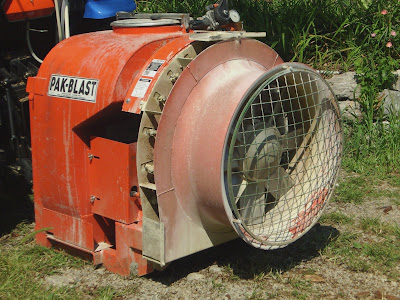
Open the Pod Bay Doors Hal.


I'm sorry Dave, I'm afraid I can't do that.


Heh, no this isn't the escape pod from the International Space Station... It's our new air-blast vineyard sprayer. It arrived today on a flat bed trailer. It's a few years old and we got a good deal on it. We'll clean it up and use it once the vines go dormant this fall to spray lime sulfur fungicide on the canopy once we move the sheep out of the vineyard.


Monday, August 29, 2011

Cynthiana

The Cynthiana grape is only marginally successful in Iowa because it has a very long growing season and in some years we get a hard freeze early enough in the fall that it is not yet ripe when the vines shut down for the winter. We put this vine in our vineyard because we're pretty optimistic that we are far enough south in Iowa that we have a good chance of getting it to ripen in most years. This is the first year these vines have produced a decent crop as it has taken a while to get them established in our vineyard. We think it is worth trying to grow this grape here because it makes a very good, full-bodied red wine when fully mature, and fills a niche that most of the cold-climate hybrids are not able to fill. It ages well, responds well to oak, and has lots of tannins, which smooth out as the wine ages.

Cynthiana is considered to be a genetically true American grape (Vitis aestivalis) as opposed to the more familiar European grapes of the genus/species (Vitis vinifera), such as Cabernet Sauvignon, Chardonnay, and Pinot Noir. It was grown extensively in the Eastern US, particularly in Virginia where it was first noted, and also the Midwest prior to Prohibition, which pretty much wiped out the wine industry east of the Rocky Mountains for decades. It is grown extensively in Missouri and parts further south, and is actually the state grape of Missouri. It is often made into a high quality dry red which is aged in oak barrels, and once bottled, some additional aging is usually recommended before drinking.

Wines made from cold climate hybrid grapes (the majority of the grapes grown in the Upper Midwest) tend to be a little thin when it comes to mouth feel so being able to grow the non-hybrid Cynthiana in this area really fills an important space in a cold climate winery's repertoire. New hybrid reds are coming along and eventually grape breeders will come up with other combinations of cold-hardiness, good disease resistance, and good red wine qualities, maybe knocking Cynthiana of its perch. In the meantime, Cynthiana, also known as Norton, is holding down the fort for cold climate winemakers looking to make a dry, red wine.

This is an exciting time in cold climate grape breeding and research. There are interesting crosses being made with obscure Eastern European and Russian grapes that have just recently made their way across the Atlantic. There is a huge blank canvas out there, with lots of room for new grapes to take their places in the cold-climate viticulture lexicon.

The more, the merrier!

It comes at the perfect time because more and more wine drinkers seem to be in the mood to try new things. That's great news for winemakers in areas of the country not considered traditional wine regions, as it allows for the development of regional signatures or fingerprints, so to speak. It's a fun time to be learning the ropes. Things are certainly moving quickly as more research and breeding produces better hybrids with the characteristics necessary to succeed in the challenging conditions in the Upper Midwest. It also fits nicely into the Local Food movement. The State of Iowa has been out in front in trying to support and demystify the wine experience by getting out of the way and allowing wineries to do tastings and sell wine at farmer's markets, treating wine as the agricultural product it is, and enabling the public to really get to know their local winemakers and grape growers. It's benefited the wine industry here in a big way (as well as wine drinkers!!!).


Here is a closeup of our Cynthiana grapes as they approach ripening. We are probably still at least three weeks from these being ready to harvest. Greg will be checking the brix (soluble sugars) with his refractometer in the next several days to determine where things stand. We'll need to net these vines soon because the birds will start grabbing them as sugar content goes up.


Friday, August 26, 2011

Log Rolling...

One of the hardest things we had to do when we turned this former cow pasture into our home and vineyard was taking out several huge oak trees. I made a commitment at the time to turn the logs into something other than firewood. Eventually.

Since we built the garage/apartment back in 2005, we've been procrastinating and postponing building the rest of the house. I guess we've become comfortable in our cozy one bedroom "loft" and the longer we live in it, the harder it is to imagine having a full sized house. Really the only time we notice how small the place is (880 sq ft) is when we have company or when trying to find something in the overcrowded kitchen cabinets, closets, or the garage. We really do need more space around here and have started thinking again about what we'd like to build. We even attended the Greater Des Moines Home Expo to check out about a dozen new homes by various builders and to talk to some of them about our potential project.

Anyway, earlier this month we took a trip out to Wyoming and Idaho with my parents, and we stayed in a cabin/lodge on the South Fork of the Snake River. The home was gorgeous and had been constructed with salvaged timbers from an 80-year-old factory that had been torn down.

This got me to thinking again about the numerous logs just sitting around the property, waiting for me to decide what to do with them. The easiest solution would be to find someone with a portable sawmill that would be willing to come on site and mill all of these logs into usable lumber. Some of these logs have been on the ground for over five years and I've been sort of half-heartedly trying to find a portable sawmill for at least three years. After numerous leads fell through, and after putting it on the back burner several times, I finally located a guy on CraigsList about an hour from here with a portable sawmill. I contacted him last week and he said he'd work us in sometime in October. Great! Well, that gave us plenty of time to plan on what to do with all of this wood. Greg and I are planning to build a small building this fall and some of that lumber would come in handy when we finish the inside, including trimming around the windows, possibly some tongue and groove ceiling or paneling, possibly the floor (?) and definitely some pieces of rustic furniture.

We discussed various options for cutting the wood, and finally settled on 1 x 6 boards for flooring and 6 x 6 timbers that could be used for any number of things, and milled into 1 x 6 boards if we ended up not needing the timbers. On Monday of this week, I got a call from Duane, the guy with the mill, and he said he'd had a cancellation and would I like him to come on Thursday. Of course, I said, without really thinking about what that actually means, including moving some logs out of the front sheep pasture, and figuring out where we were going to dry and store it.

On Wednesday evening, Greg and I moved several logs to one staging area using the tractor and a pull-strap, and one really long log had to be cut into two pieces in order to move it. It was probably 3o feet long.

On Thursday morning, Duane showed up with his sawmill and after some discussion he decided to set up the saw on the top of the hill by the vineyard, which is pretty much the only level spot on the entire property. Not an exaggeration! There were at least a dozen logs up there and we decided that I'd take the tractor and haul all of the logs we'd staged out front up to the vineyard and he would mill all of the logs up there in one spot. After Duane and I manipulated the first log onto the saw, he went to work cutting it into boards and I headed down the hill to start hauling the logs up the hill with the tractor. These logs were all somewhere around 15 to 20 inches in diameter and 14 to 18 feet long. I have no idea what they weighed but based on some of the timbers they yielded, it would not surprise me if some of them exceeded two thousand pounds.

This sawmill was pretty amazing. The logs are rolled onto some curved arms that reach down to the ground. The arms then hydraulically lift the log up onto the platform, and then a giant band saw is lined up and makes a cut horizontally from one end of the log to the other. The log is rotated 90 degrees and another cut is made, and this is repeated until the log is a four sided beam. At that point, the beam is cut into boards or timbers, making the best or most efficient use of the log. Here are a few of the timbers, including one that is 17 feet long.


Once the lumber comes off the mill, it is stacked and the scrap thrown off to the side in a big pile.


Here is a picture of the stack.
This is about half of the logs. Needless to say, he ended up getting about ten logs milled before running out of daylight, and I have at least that many left to go. Most of the really big ones are done and I think, including the timbers, we are at right around 2000 board feet of milled lumber. The ends of a few of the timbers will need to be cut off to get rid of some bug damage but for the most part, these logs are incredibly solid all the way through. I was pretty surprised that there wasn't more than this little bit of bug damage, given how long these logs have been lying around outside.

By the time we're done with the rest of the logs, I don't think we'll have any trouble getting enough wood to cover any size floor in whatever size house we end up building, plus we have nine timbers that can be used in the house possibly in a timberframe vaulted great room. The flooring will be six-inch wide planks. Some of these logs are over a hundred years old and have very distinctive grain. We'll dry it and play around with some different stains to see what the future floor will look like.

On Saturday morning, Greg and I moved some stuff around in the garage to make room for storing the wood. We initially thought we would need to build a kiln to dry the wood before it could be used, but after talking to the guy with the sawmill, our heated garage should work just fine to get the wood dry enough to use. Here's a picture of where the wood will be stacked.

We'll set up a small fan to circulate the air so the wood dries uniformly. Tomorrow we plan to move the remaining four timbers and all of the 1 x 6 and other miscellaneous boards into the garage so it can start drying as well.

If we get the little building built this fall, we'll have all winter to play around with different things to finish the inside of it. In particular, there is so much scrap left from the mill that we can sort through and rip with the table saw to make furniture quality boards out of. I see some new tools in Greg's future... We plan to put up the little 12 x 16 building and at least get it to the point of being weathertight before winter really gets going and it will be a nice project to work on through the winter. We plan to put a gable loft in it for storage of things like Christmas, luggage, camping gear, and so forth, all of which is currently taking up shelf space in the garage. The majority of the space will be a spare "cabin" for guests.

Saturday, July 30, 2011

Honey, it's hot in here...

Do you know what comes with Late July heat and humidity? Tons of wildflowers, that's what. I've been checking on my beehives about once a week this summer, watching them slowly build up the comb and fill it with eggs. It's pretty interesting to see the eggs, which are only two to three millimeters long, white and attached to the very bottom of each comb cell, quickly grow into a grub-like larvae that get bigger and bigger until they fill the entire cell. At that point, the bees seal up the cell and each larva transforms into a fully developed bee in about 21 days.

While I've watched the bee population expand in the bottom two boxes of each hive, I've added additional boxes one by one, and these have been filled with pollen and honey, and eventually just honey. I put the sixth box on each hive today and they'll probably need at least one more each by the end of the summer. I plan to steal the top three boxes off each hive around Labor Day and extract the honey and bottle it. I've already stolen a frame (about two weeks ago) just to see how much the yield would be, and how it tastes. Since it was early season honey, it had a very mild flavor and a light color. As the season progresses, and the bees forage for nectar further from the hives, on more and more diverse flowers, the honey will be darker and the flavor will be more intense in character. A lot of commercial beekeepers collect the early honey in mid summer and leave the darker honey for the bees to feed themselves through winter. Since this is the first year for these hives, I've decided to wait until September to see how much honey they actually make before making the decision about how much I'm going to steal from them. I'll be able to compare the September honey to the sample I collected a few weeks ago to see how much of a difference there is between the two.

If I end up pulling off three boxes from each hive, I'll end up with a total of 60 frames. If each frame yields two pints, I'll end up with roughly 15 gallons of honey, and that's still leaving at least two full boxes of honey on each hive to get them through the winter. As I was lifting the boxes off the stacks this morning, there were two that were 100% full of honey and I was shocked at how heavy they were.

I took each hive apart this morning because I wanted to get a look all the way down in the bottom box on each hive to see if there were any empty frames or if they'd all been built out with comb. I mainly wanted to make sure there was enough room for the queens to keep producing eggs through the rest of the summer. It looks like that is the case. In the process, however, the bees got pretty cranky and I ended up getting stung three times; twice on my right hand, and once through my suit just above the knee. I had one whole hive taken apart and had to walk away for a few minutes to see if they would settle down, and they really didn't. I ended up closing things up and getting out of there but I did add the 6th box on top of each hive before putting the covers on. Greg's going to have to put together another 20 frames soon because with all of the wildflowers blooming right now, they are definitely not even close to shutting down the honey production. I will probably keep adding boxes until I see the first ragweed blooming, then I'll pull off what I'm going to keep, and let them make honey out of the fall ragweed bloom, which they can keep. I've had several beekeepers tell me ragweed honey is not particularly tasty but the bees apparently don't care.

Monday, July 4, 2011

Happy Independence Day!

We'll be firing up Sunny, the clay oven for homemade pizza tonight, and listening to the outlaws up the road fire off the artillery shells or whatever the hell that thing is that goes off every 4th of July...

Wednesday, June 1, 2011

Shoots!

Seeing as this is a "Vineyard Blog," how about some blogging about the vineyard? As usual, spring comes roaring in with lots to do, including mowing, spraying, training vines, and scouting for insect and fungal pests. There's plenty to do out there this time of year. Once the temperatures start getting up in the 80s you really need to stay on top of any disease pressure because warm wet springs set the tone for the rest of the growing season. Diseases that take hold on the leaves and blooms are impossible to eradicate later in the summer once they've affected the fruit.

So, what am I up to out there today? Well, I'm working on the Sabrevois vines, which are well ahead of the Traminette and Cynthiana vines in terms of growth stage. They are really taking off. We grow this particular grape on a trellis style called Vertical Shoot Position. This trellis is typically used with upright growing cultivars and there is a main wire that holds the horizontal cordons, the lateral arms from which the rest of the shoots grow vertically. The main wire is roughly 40" above the ground and then at eight-inch intervals above that there are additional pairs of catch wires. These catch wires are attached on either side of the wooden vineyard posts with little plastic clips that hold them in place during the growing season. These movable catch wires provide a sort of cage that holds the shoots straight up, allowing for good air circulation and good sun exposure for the fruit, which is essential to ripening it. What I'm doing this week is walking along each row of vines and tucking the shoots, some of which are a couple of feet long, inside these catch wires. I'm spreading the shoots out and untangling the ones that have wrapped around each other, and I'm also stripping any new shoots that are coming out of the lower portion of the trunk. I usually let the sheep do this part but I have them out of the vineyard right now because we are spraying a fungicide that they cannot ingest. There is a window of time between the last spray of this particular fungicide and when the sheep can get back in there to graze, so the vineyard is off limits for the time being. Not to worry though, I have run hot wire around the house and I have them currently mowing part of the yard and an area with a lot of brush and weeds that have been a pain in the butt for a couple of years. They're making quick work of it and it will soon look as nice as the rest of the yard.

The Sabrevois grapes are starting to bloom this week. The grape blossoms smells incredible. There's really nothing that smells like a blooming vineyard, but it only lasts for a few days and then it's gone. We've had several days of warm, dry weather which bodes well for good fruit set. This grape is the first to bloom, out of the three cultivars we are growing. It typically ripens in Iowa in mid to late August. We have five rows of roughly 60 vines each of this grape and it is absolutely full of tiny clusters of flowers which will become clusters of tiny grapes in a few days.