I'm beginning to seriously question the intelligence of these sheep.
This afternoon, I was busily working away, trying to get done so I could run some errands in town. I have the windows open because it's 73 degrees today and absolutely beautiful outside. I took my headphones off for a few minutes and heard one of the lambs making a huge racket. I went to the window and saw Cocoa in the sheep pen. He was on the opposite side from the gate pacing back and forth along the fence. The rest of the sheep were on the other side of the fence eating grass, ignoring him. I watched for a few minutes and realized he was stuck in the pen. Well, sort of. The gate is 16 feet wide, and is wide open during the day so they can come in and out whenever they want and also so I don't have to run out there and let them in if it storms. I close them up in there before dark every evening but other than that, they're on their own.
Clearly, he'd gone in there for some reason and then got upset because the other sheep were outside the pen and he couldn't figure out why or how to get out. This went on for several minutes and he finally flopped down on the ground in frustration. I thought about going out there to help him but less than a minute later, he leaped to his feet, dashed through the gate and ran as fast as he could around to the other side of the pen where the rest of the sheep were eating. Frantically baaa'ing the entire time.
Oh, did I tell you? He did the exact same thing last week.
I do not know how these things ever evolved in the wild...
Thursday, August 20, 2009

Tuesday, August 18, 2009
What's up in the vineyard?
I've been terribly negligent on keeping this blog up to date, so it's time for an update. So, uhhh, what's happening out there? Well, most of the vineyard chores at this point involve controlling grass and weeds, tying/training the vines to the trellis, and making sure things stay wet enough. There are no grapes to harvest this year because the vines are still too young. We will probably let the two-year-old vines produce a half crop next year assuming they come out of dormancy in better shape than they did this year. We will be taking off the grow tubes in the next several days so the vines can start hardening off for winter. These are plastic tubes that are about 30" tall, and surround the newly planted vines. They create a protective greenhouse for the vine while it begins to grow. They also help direct it up the bamboo stake toward the wire, and protect the base of the vine from rabbits and so forth. They go on right after planting, and come off in mid August. As we take them off, they get nested into bundles of 20 and stored until next year when we plant the next batch of vines.
Since early July, we have gone through several weeks with minimal rain. We've gotten some but not enough. Watering is a hassle but with new vines, one thing you can't do is let the roots dry out. Older vines, with much deeper roots handle heat and drought stress better than new vines. We have pretty heavy soil here, clay loam, which holds water well so what percolates down tends to stick around.
Anyway, we hand water when necessary and this entails putting a big polyethylene tank in the back of the truck, and driving up and down each row, putting a couple of gallons on each vine. We have a small pond right next to the vineyard and when we get decent snow in the winter and normal rain in the spring, the pond is full to the brim through late June. This year was no exception. We had a pretty wet spring and were able to store plenty of water in the pond. We have a trash pump that we keep by the pond and it sucks water up through a hose and into the tank. The tank holds about 125 gallons of water and we have 12 rows of new vines so it takes several trips back and forth. We put about 1500 gallons of water on the vines each week that we don't get at least an inch of rain. Very time consuming. Also, it takes two people, one driving, one holding the hose. Last week I rigged up a little dealie with a piece of metal pipe that extends out almost over the vine, and a couple of clamps attached to the tailgate so I could just open the valve and then run and jump in the front seat, and drive along the vine row, and water by myself. Before I had a chance to try it out though, we started getting rain every couple of days again so I haven't tested it out yet. Anyway, that will free up one person to do something else.
The long term solution, however, is to run drip irrigation. It's expensive but the value of time saved (and gas driving up and down the the vineyard rows with a half ton of water in the back) is worth something so we are probably going to do it either this fall, or next spring before planting gets underway.
I'm totally intrigued by the idea of putting some alternative energy to use in the vineyard. I'm already doing this a little bit with the "mutton mowers" as an alternative to mowing and weeding. Anyway, moving water from place to place is an ideal task for a solar or wind project. I subscribe to Home Power magazine which is a really good source for ideas and products geared toward do-it-yourself alternative energy projects. The drip irrigation will require a huge poly tank of at least a thousand gallons, which we will put at the highest point of the property (which happens to be just north of the vineyard). My idea is to use either a small wind turbine or solar panels to a battery bank (or possibly a hybrid of the two) to pump water from the pond to the poly tank, where it will be filtered and stored. The vineyard will then be divided into zones and the flow controlled by a manifold that allows only a few rows at a time to be watered on any given day. That way I can really deeply water 3 or 4 rows at a time on a given day, and then move on to the next batch the next day. Hopefully there will be enough elevation of the tank that gravity can handle most of the pressure needed to push all of that water out to the emitters, but if I need an electric pump to boost the pressure, I'll break down and buy one and run it off a battery bank charged by the panels too. Hopefully it won't be needed. I can drip irrigate overnight and refill the tank during the day when the wind blows and the sun shines. I figure if there's no sun, it's probably raining and I won't need to fill the tank anyway. There's no electricity running out to the vineyard and this seems like an ideal application for solar/wind/hydro. I've even considered buying a big thousand gallon tank that I can put on a trailer, and attach the turbine and solar panels to one side of the trailer. It would look like the Beverly Hillbillies meets Mad Max and would be a self-contained little electricity generator of a sorts, and I can move it to various vineyard blocks, which by the time we finish planting will be spread out on the 40 acres in various locations, park it with the panels facing the sun, and hook up to the manifold for each vineyard block, and let er rip...
As a bonus, that thing could be parked next to a future hoop house/greenhouse and used to provide lighting and irrigation to a winter vegetable garden when not needed in the vineyard. I've been looking at hoop houses online and have the perfect place for one just to the south of the house. I can't grow tomatoes and peppers year round here, but I could probably keep some lettuces, kale/collard/mustard greens, spinach, and cold weather veggies like broccoli and squash going well into December, and then get started in early March with lots of early spring veggies. It will also give me a lot of space to root cuttings of grape vines to either replenish dead ones or expand the vineyard to more of the acreage., and play around a little bit with crossing grapes and developing new cultivars. The possibilities are endless...
Now that I have these sheep, I have an unlimited supply of "fertilizer" in handy "pelletized" form. I've even seen people use horse manure composted in a trench inside a hoop house to raise the temperature several degrees as it breaks down. We're surrounded by people with horses, and plenty of poop to spare.
The thing about a hoop house is it's cheap, movable and when it gets hot you just roll up the sides to the open air. Once it's cold, if you garden in raised beds, and insulate the sides with rigid foam, you can even run PEX tubing under the growing beds and circulate it through a big holding tank attached to a solar collector on the outside of the greenhouse, and provide toasty warm growing beds. With a big enough tank inside the greenhouse, you can probably store enough heat to moderate the temperature of the greenhouse overnight as long as you have good sunny days during the day to heat the water up. You definitely could if you paint the tank black and put it where it can absorb heat from the greenhouse during the day.
So many ideas, so little time.
Since early July, we have gone through several weeks with minimal rain. We've gotten some but not enough. Watering is a hassle but with new vines, one thing you can't do is let the roots dry out. Older vines, with much deeper roots handle heat and drought stress better than new vines. We have pretty heavy soil here, clay loam, which holds water well so what percolates down tends to stick around.
Anyway, we hand water when necessary and this entails putting a big polyethylene tank in the back of the truck, and driving up and down each row, putting a couple of gallons on each vine. We have a small pond right next to the vineyard and when we get decent snow in the winter and normal rain in the spring, the pond is full to the brim through late June. This year was no exception. We had a pretty wet spring and were able to store plenty of water in the pond. We have a trash pump that we keep by the pond and it sucks water up through a hose and into the tank. The tank holds about 125 gallons of water and we have 12 rows of new vines so it takes several trips back and forth. We put about 1500 gallons of water on the vines each week that we don't get at least an inch of rain. Very time consuming. Also, it takes two people, one driving, one holding the hose. Last week I rigged up a little dealie with a piece of metal pipe that extends out almost over the vine, and a couple of clamps attached to the tailgate so I could just open the valve and then run and jump in the front seat, and drive along the vine row, and water by myself. Before I had a chance to try it out though, we started getting rain every couple of days again so I haven't tested it out yet. Anyway, that will free up one person to do something else.
The long term solution, however, is to run drip irrigation. It's expensive but the value of time saved (and gas driving up and down the the vineyard rows with a half ton of water in the back) is worth something so we are probably going to do it either this fall, or next spring before planting gets underway.
I'm totally intrigued by the idea of putting some alternative energy to use in the vineyard. I'm already doing this a little bit with the "mutton mowers" as an alternative to mowing and weeding. Anyway, moving water from place to place is an ideal task for a solar or wind project. I subscribe to Home Power magazine which is a really good source for ideas and products geared toward do-it-yourself alternative energy projects. The drip irrigation will require a huge poly tank of at least a thousand gallons, which we will put at the highest point of the property (which happens to be just north of the vineyard). My idea is to use either a small wind turbine or solar panels to a battery bank (or possibly a hybrid of the two) to pump water from the pond to the poly tank, where it will be filtered and stored. The vineyard will then be divided into zones and the flow controlled by a manifold that allows only a few rows at a time to be watered on any given day. That way I can really deeply water 3 or 4 rows at a time on a given day, and then move on to the next batch the next day. Hopefully there will be enough elevation of the tank that gravity can handle most of the pressure needed to push all of that water out to the emitters, but if I need an electric pump to boost the pressure, I'll break down and buy one and run it off a battery bank charged by the panels too. Hopefully it won't be needed. I can drip irrigate overnight and refill the tank during the day when the wind blows and the sun shines. I figure if there's no sun, it's probably raining and I won't need to fill the tank anyway. There's no electricity running out to the vineyard and this seems like an ideal application for solar/wind/hydro. I've even considered buying a big thousand gallon tank that I can put on a trailer, and attach the turbine and solar panels to one side of the trailer. It would look like the Beverly Hillbillies meets Mad Max and would be a self-contained little electricity generator of a sorts, and I can move it to various vineyard blocks, which by the time we finish planting will be spread out on the 40 acres in various locations, park it with the panels facing the sun, and hook up to the manifold for each vineyard block, and let er rip...
As a bonus, that thing could be parked next to a future hoop house/greenhouse and used to provide lighting and irrigation to a winter vegetable garden when not needed in the vineyard. I've been looking at hoop houses online and have the perfect place for one just to the south of the house. I can't grow tomatoes and peppers year round here, but I could probably keep some lettuces, kale/collard/mustard greens, spinach, and cold weather veggies like broccoli and squash going well into December, and then get started in early March with lots of early spring veggies. It will also give me a lot of space to root cuttings of grape vines to either replenish dead ones or expand the vineyard to more of the acreage., and play around a little bit with crossing grapes and developing new cultivars. The possibilities are endless...
Now that I have these sheep, I have an unlimited supply of "fertilizer" in handy "pelletized" form. I've even seen people use horse manure composted in a trench inside a hoop house to raise the temperature several degrees as it breaks down. We're surrounded by people with horses, and plenty of poop to spare.
The thing about a hoop house is it's cheap, movable and when it gets hot you just roll up the sides to the open air. Once it's cold, if you garden in raised beds, and insulate the sides with rigid foam, you can even run PEX tubing under the growing beds and circulate it through a big holding tank attached to a solar collector on the outside of the greenhouse, and provide toasty warm growing beds. With a big enough tank inside the greenhouse, you can probably store enough heat to moderate the temperature of the greenhouse overnight as long as you have good sunny days during the day to heat the water up. You definitely could if you paint the tank black and put it where it can absorb heat from the greenhouse during the day.
So many ideas, so little time.
Monday, July 27, 2009
vines

That's what this is all about, right? Well, after spending the weekend in the vineyard training new trunks on most of the Cynthiana vines, I'm finally coming to grips with how cold it got this past winter. We had temperatures in January down close to -20F. Greg has a couple of temperature probes up in the vineyard, one on the top of the hill and one down by the creek, where you would expect cold air to accumulate. He built a spreadsheet to keep track of the temperatures over the winter, and those probes plug right into a USB port on his laptop, which allows him to dump the data into Excel. There were definitely times when the top of the vineyard was several degrees warmer than the lower elevation part of the vineyard.
We originally assumed that much of the winter injury we were seeing was likely a result of the really cold spell we had in January. Things got started pretty late this spring in terms of new growth and we were holding our breath until we started seeing a lot of new growth from the base of most of the plants. We have planted two grapes that are in the upper edge of their hardiness range where we are, and both went through the wringer this past year. There's a pretty wide range of foliage in the Cynthiana, from puny, weak looking plants, to huge, very lush vines arching way up over the high wires above our heads. We've been doing some research and Greg suggests that it wasn't necessarily the January ultra-frigid temperatures that caused a lot of the canes and trunks to die back to the ground, but rather, it was the extreme November drop in temperatures that took the vines by surprise. We had a fairly warm spell in late October and early November and then one night the temperature plummeted to 18F after a fairly warm day. Vines are generally completely dormant by January but that kind of cold, that early in the fall may have caught a lot of the vine tissue still full of sap, and not hardened off enough to survive it. I think he may be right. Green grape vine canes break pretty easily (think fresh asparagus) but when they start hardening off, the soft green tissue is replaced by brown woody tough tissue that, while remaining pretty flexible, it is much more difficult to break. We had so much rain in Spring of 2008 that we got tremendous first-year growth out of the vines. It may have just been too much vegetation to harden off completely before things got really cold. Vine tissue containing a lot of water would have had a lot of ice forming in the cells and that may have sealed their fate.
I was pleased to see how much growth we got from the base of the vines this year, which enabled us to replace the damaged trunks and train new ones back up to the wire. We still lost some vines completely and will be replacing them with rooted cuttings that I will nurture over the winter under grow lights so they'll be ready to go in the ground next May. We've had a lot of rain again this year, but not the deluge we got last year. We now seem to be entering a dry spell which should help slow down the vegetative growth, and assuming we don't have a very wet August, things should start hardening off for winter better than they did last year. We're also going to try some viticultural practices that we've been reading up on that deal with protecting the crown of the vine, which should help prevent crown gall, which we've seen on several plants, and it is directly related to trunk injury from cold. This will involve painting the base of the trunk white, to reflect sunlight so the night/day temperature in the trunk is less extreme, and also finding some kind of tool that we can attach to the back of the tractor that will go along next to the vine row and mound up the soil over the bottom 6 to 8 inches of the trunk. The crown gall problem is something that we are going to need to find a solution for if these two varieties are going to be growing at Bluff Creek Vineyards. Whatever protection methods we can come up with for the Cynthiana and Traminette vines that we planted in 2008, we will also apply to the new 2009 vines, and hopefully we won't be dealing with this same issue again next spring.
Tuesday, July 14, 2009
A post wherein I discuss worms and maggots (you have been warned)
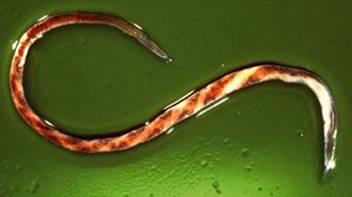
Over the past two days, I've been paying particular attention to Cocoa. Partly because he is so interesting to watch and partly because he seems so independent and often is separated from his flock by quite a distance and I'm not sure why. Anyway, on Sunday I noticed that he was lying around and not eating when the other sheep were grazing. I made note of it but didn't think a whole lot about it. I attributed it to him being smaller, younger and not as hungry.
Yesterday morning when I went out to the sheep pen to let them out to their pasture, and to feed Sophie, everyone but Cocoa met me at the gate, happy to see me (or at least any treats I might have) but Coke was lying over in the grass by himself. His head was up and he was watching me but he didn't make a move to get up and come over to me. I went in the pen and walked toward him and he jumped up and ran to catch up with the rest of the sheep. I checked on him a few times during the morning and sometimes he was eating grass, and other times he was curled up in the grass, not sleeping, just hanging around. Not Normal; at least to my inexperienced eye.
I fired off an email to Kristin, the woman who sold me the sheep, and she reminded me that the first thing to check for is worms. You do this by catching the sheep, pulling down the lower eyelid and checking the color on the inside of the eyelid.
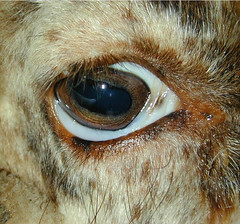
It should be dark pink. If it is pale pink to white, worms are likely the cause. The pallor is a sign of anemia. In sheep, intestinal worms attach to the stomach lining and the blood loss causes anemia in a hurry. The sheep were wormed the day before I brought them home, about two and a half weeks ago, so it didn't click that I had a worm problem until I went back out there, caught him and looked at his eyelids. Sure enough, pale pink, almost white. I called the vet and scheduled a visit for this morning at 10:00. I might have been able to handle this myself but I really wanted some professional guidance this first time. I'm glad I called the vet.
Kristin had suggested I give him a little extra feed and also check the site where he'd been neutered. I managed to catch him again but he was struggling so much, I only got a cursory glance "down there" and did not see anything alarming.
When the vet came this morning, she quickly assessed the situation and we decided to worm everyone. While she had Cocoa on the ground, she wormed him and then took a look between his back legs and sure enough, the snip site had opened up. I'll save the clinical data for another time, but to summarize, maggots were involved.
Obviously, I was horrified but she said it was common, not to worry, and got some stuff to spray to help keep it clean and the flies off. She injected an antibiotic to be on the safe side, then let him up off the ground and he tore off to rejoin his friends.
I got a quick lesson on worming, had a conversation about Coccidosis, Flies, and barn/pen sanitation, and she gave me the stuff to spray on Cocoa's open wound (He's gonna love me by the end of this week) some extra wormer for the lambs, and some stuff to put in their drinking water for Coccidosis, a parasite not treated by the oral wormer she used. Kristin had also indicated this might be a possibility if worms were ruled out as the problem. Hopefully I'm on top of the worm situation now and Cocoa will be back to his usual self in short order.
Based on Cocoa's reaction (he's about 25 lbs) the correct sheep behavior, when grabbed by the back legs is to turn into a kangaroo and attempt to spring away. Hard to imagine with a 100 lb Jilly Bean or Tebow. I'm going to need some practice before I can wrestle one of the adult sheep to the ground. Maybe I'll practice on Sophie. She'll probably think it's a game...
Sunday, July 12, 2009
Hey, er, I mean Hay!
One thing that grows really well on our farm is grass. We have lots of it. Tons of it actually. Every year since we built our house, we've harvested the hay on about 8 acres. Well, actually we've brought people in to harvest it since we don't have the equipment necessary to do it ourselves. In the last several years, we've had the same guy cut it, rake it, and bale it. It's fascinating to watch these huge (big boy) tractors and implements convert what is essentially dead grass into these huge, perfect, round bales of hay. The smell alone is incredible (unless you have hay fever allergies). We have a mixture of various pasture grasses including orchard grass, fescue, brome and several other grasses I can't identify, as well as some weeds/wildflower species mixed in.
The way it works is we have a verbal agreement with "Tim" who cuts and bales, and takes half of the bales as payment. That leaves us with the other half of the bales. Up until this year, we have had no use for hay because we have had no livestock. Tim bought our half of the bales to use for his cattle or to sell to others. Now that we have started planting vines, we've used up a good bit of our hay field so over the past two years we've gotten less and less hay. I think the first year we got 22 or 23 big round bales. Last year we were down to 19 or 20, and after planting this year's vines, we are down to 12. That's not a lot of hay.
Here's the thing... Now I have five sheep to feed through the Iowa winter. I need to plan for feeding them hay from about the first of November through the beginning of April, so I need to plan on between five and six months' worth of hay. I likely won't need that much because we usually don't get snow until later in November or early December but you never know. I've talked to Tim a bit about it and what I think I will do to make it easy is sell him my half of the round bales, which I think weigh about 600 to 700 lbs and since he has a small square baler he can sell me back enough square bales of good grass/alfalfa mix hay to get me through the winter.
I've calculated that I need a minimum of 75 square bales to cover me for six months, assuming the bales weigh around 40 lbs. I'll end up owing Tim about $150.00 when it is all said and done.
I should still come out ahead though because I rent 9 acres of pasture to my neighbor which will more than cover my cost for the additional hay.
Here's what our hay field looked like after it was cut this year.
Here's a picture of the rake, piling it up into
long rows to be picked up by the baler.
Here's what the hayfield looks like now that it is baled. You can also see the two-acre vineyard on the top of the hill to the right.
Tim will be back to move the big bales out of the field in the next several days and we are expecting a bunch of rain this week, which will green everything up again. In some years we might get a second cutting but that normally only happens when there is plentiful rain through late July so it is definitely not the norm for us.
The way it works is we have a verbal agreement with "Tim" who cuts and bales, and takes half of the bales as payment. That leaves us with the other half of the bales. Up until this year, we have had no use for hay because we have had no livestock. Tim bought our half of the bales to use for his cattle or to sell to others. Now that we have started planting vines, we've used up a good bit of our hay field so over the past two years we've gotten less and less hay. I think the first year we got 22 or 23 big round bales. Last year we were down to 19 or 20, and after planting this year's vines, we are down to 12. That's not a lot of hay.
Here's the thing... Now I have five sheep to feed through the Iowa winter. I need to plan for feeding them hay from about the first of November through the beginning of April, so I need to plan on between five and six months' worth of hay. I likely won't need that much because we usually don't get snow until later in November or early December but you never know. I've talked to Tim a bit about it and what I think I will do to make it easy is sell him my half of the round bales, which I think weigh about 600 to 700 lbs and since he has a small square baler he can sell me back enough square bales of good grass/alfalfa mix hay to get me through the winter.
I've calculated that I need a minimum of 75 square bales to cover me for six months, assuming the bales weigh around 40 lbs. I'll end up owing Tim about $150.00 when it is all said and done.

I should still come out ahead though because I rent 9 acres of pasture to my neighbor which will more than cover my cost for the additional hay.
Here's what our hay field looked like after it was cut this year.
Here's a picture of the rake, piling it up into

long rows to be picked up by the baler.
Here's what the hayfield looks like now that it is baled. You can also see the two-acre vineyard on the top of the hill to the right.

Tim will be back to move the big bales out of the field in the next several days and we are expecting a bunch of rain this week, which will green everything up again. In some years we might get a second cutting but that normally only happens when there is plentiful rain through late July so it is definitely not the norm for us.
Saturday, July 11, 2009
Day Labor
Well, sort of. Today was the beginning of the beta test phase for the vineyard sheep. We're starting them in a small patch of the vineyard (four rows of the new 2009 vines) to see how they do and how best to use them. Use Them? That sounds terrible! I know, but really it's a win-win. They love weeds. I hate weeds. Grapes hate weeds. The sheep could care less where they are as long as they have something to eat. They might as well be in my vineyard.
These sheep are so funny to watch. You really only have limited options in how to direct them or get them to cooperate with you. Mainly, that involves, again, the food and the bucket. They will pretty much go in the same general direction as you, as long as you have the bucket and are shaking the feed in it. They startle easily though, and will go scattering off in all directions. They hate to be apart from each other so as soon as the perceived danger passes, they clump back into a big woolly blob again.
Greg went out to the vineyard this morning and made some final adjustments to the hot wire and came back to the house. I figured he could follow us and sort of push us along if things didn't go exactly according to plan when I let them out of the gate. 

We fed Sophie and took her out of her pen on her leash, opened the main sheep enclosure gate, and I started shaking the hell out of that bucket. We walked as a group toward the pasture gate. I opened it, walked out and off we went. From the gate to the vineyard is about 400 feet or so, straight down the north fence line. Greg and Sophie brought up the rear and when one or more sheep stopped to eat on the way, he encouraged them forward. We all walked out to the vineyard, through the gap in the hot wire and down one of the vine rows. Once they were all in, Greg closed the gap, completing the circuit of the hot wire. I dumped the feed on the ground and stepped back. They swarmed the little pile of food and I scooted around them and stepped over the hot wire, which is about 12 inches off the ground. He has it pulled taut and it's definitely live.

Once the sheep finished their snack, they got to work eating the weeds (an overwhelming task at this point because we did not spray these four rows to kill the weeds when we sprayed the other 8 rows). They ate, and ate, and ate, and ate and then took a nap. Then they ate, and ate, and ate, and ate, and then took another nap. So it goes. They work when they want, and when they need a break, they just take one. I think these are Union sheep. When one flops down for a nap, they all do. It's hot today and I realized that there really isn't anything out there that provides them with shade so I took an 8 x 6 blue tarp and some bungee cords, and rigged up a nice shady tent for them, using the four posts of two adjacent H-braces on the north end of the vineyard.
Greg and I watched for a while to see which one of them tested out the hot wire first. My bet was on Cocoa. He has been the most inquisitive of the three lambs, and can't seem to keep from poking his nose into anything new that enters his environment. Like the other day with my tool belt. I had set it down on the ground and he immediately came over and checked out each pocket.
Anyway, it didn't take long for him to get pushed into the hot wire by the yearling wether I named Tebow. From the moment these sheep got here, Tebow has been head butting the lambs all over the place. He does it if they're in his way, or if they're trying to eat out of the same food pan, or just for the heck of it. He has a thing about ramming them. They just seem to take it in stride, like it's a normal thing. He does it to Jill too but she just turns around and knocks him right back, and I think she has at least 40 lbs on him at this point. She is a much more docile sheep but she is definitely at the top of the pecking order in this little flock.
Tebow knocked Cocoa into the hot wire and he actually went under it, and it zapped him. After a few moments of panic, he managed to leap over it back into the row, none the worse for the experience. Sheep hate to be singled out so once he was outside the hot wire, all he could think about was getting back in. The adult sheep seem to understand the hot wire already. It looks just like the hot wire at the farm they came from. The lambs apparently will need a few shocks before they figure it out. Later in the day, Tebow knocked Pancho into it and Pancho was touching two or three other sheep at the time so I think they all got a dose of it.
We are keeping Sophie tethered up there so she doesn't blunder into the hot wire. As long as she's there, the sheep should be safe. I don't think I will leave them unattended up there until we see how this is going to go. From what we've seen today, they will need to be out there a lot in order to gain control of the weed situation. Next year, we will start putting them in there a lot sooner and they should be able to keep things from getting out of hand.
There is one weed species that gets a very early start, and in fact it goes dormant but does not die over the winter, and then comes to life, even before all the snow has melted. It is the only green thing in the vineyard in March. Even the grass is still dormant at that point. The sheep should be able to clean those weeds up pretty quick so they don't become the problem they became this year. They started off as cute little dark green plants, and by the end of March had put out lovely white flowers that made the vineyard look like a postcard from Burgundy. Then, almost overnight, out came the seed pods. We did not deal with these particular weeds early enough so of course they got away from us and released their seeds. We'll be seeing them again next year as a result, but next year the sheep will be ready for them. 

The other thing I will need to do is run the mower through the rows the sheep are currently working on, cutting the grass between the vine rows pretty short. I'll probably only have to do it this year because the sheep should be able to keep up with the weeds and the grass if I put them out there in late March or early April. I noticed that the lambs were focusing on the grass instead of the weeds, and I think by cutting the grass very short, they will look for more interesting things to eat in the vine rows. This is one great big experiment and some things will work and other things won't. We'll just have to try different things until we figure out how best to work with these sheep. You cannot make them do anything they don't want to do. If there is a sheep user's manual, that statement is on page one.
They seem pretty content to stay in there for now, and as long as there's something they want to eat, I shouldn't have any problem containing them with just the one strand of hot wire.
Thursday, July 9, 2009
Hot wire (no not that one)
When I was a kid, I loved to spend weeks in the summer with my Aunt Bibby and Uncle Joe. They had a farm with cows, horses, chickens, a huge garden, and what seemed at the time like a million acres of land. They lived in a big farm house and the entire second floor was used as an attic and man was there ever some cool stuff up there. I could spend hours up there poking around in boxes of Life Magazine and newspapers from the 1930s and 40s. Incredible stuff! I never went home from there without some treasure I'd dug up in the attic.
When I wasn't sleuthing around in the cubby holes in the backs of closets I was roaming all over the farm. Yes, part of the point of being there was to earn some summer cash helping out collecting eggs in the chicken house (imagine the scene from Napoleon Dynamite without the pitcher of raw eggs) but the majority of my time was spent crawling around the barn loft, messing around with the cows, trying to get them to chase me, and basically pretending to be Laura Ingalls Wilder.
Anyway, hot wire. The whole point of getting my miniature sheep was so they could work in the vineyard, eating weeds and mowing grass instead of me having to spray herbicide for weeds and run the mower for several hours per week. In order for the sheep to stay where I want them, I need to have some form of partition so they only work in the rows where I want them to mow/weed and not go running off all over the property. Originally I had thought about using several wires attached to the vineyard posts, about 8 inches apart, forming a multi-wire fence and blocking off the ends with cattle panels or snow fence or something else that would be easy to move, but we're talking literally about several miles of galvanized wire to do the whole vineyard that way. After visiting the vineyard where I bought my the sheep, I noted that they were using a single strand of electric fence to keep the sheep where they want them. When they wanted to move the electric fence, they just rolled it up on a spool and moved it to the new rows. (by the way, that also opens up the potential of never having to mow the yard again).
Back to Aunt Bibby and Uncle Joe's farm. Back in the day, when I was around 9 or 10, I had my first encounter there with electric fence. I happened to reach out and touch it after being told by my cousins, who shall remain nameless, that it was not plugged in. After being knocked off my feet by the jolt, and vowing revenge, (and also crying), I learned a valuable lesson about electricity.
Greg spent part of last weekend attaching the hot wire to four rows of the new vines, which have yet to be sprayed for weeds. He closed the circuit and ran everything up to a battery charged by a solar panel. Neither one of us has had the nerve to touch it to make sure it is working; me, because I know very well what that feels like, and Greg, because he doesn't! We'll know soon enough when we put the sheep out there this weekend. We will both be working out there training the new vines to the trellis and we'll see for certain whether this little sheep experiment is going to work. Based on my observations in the pasture thus far, the sheep seem to select weeds over grass when they have the choice of both. In fact, I've watched them eat some incredibly unpalatable looking stuff, including the noxious, skin-shredding, multiflora rose that is endemic here, as well as the wild gooseberries, also covered in thorns, which we have all over the place. Oh, and they love poison ivy. More about that later...
We still have the grow tubes on the new vines so they are safe from nibbling, and once the vines are mature, any leaves that grow on the trunk and any water sprouts that come up from the base, down low, are fair game for the sheep because they need to be pruned off anyway. We've set the cordon wire (the lowest horizontal wire where the vine's lateral arms grow, and where the fruit develops) at about 42 inches which should be high enough to be out of reach of the sheep. They do stretch their necks and reach up when eating sometimes but I don't think they can reach the cordons. If they can, I'll just move them higher. Once the vines are weighted down with big, ripe clusters of grapes, the sheep will have to be taken out of the vineyard, as the grapes will prove to be too irresistible to pass up, even if it means climbing up on each other to get them. Based on what I've read, until the grapes are actually almost ripe, and full of sugar, there isn't much interest in them from the sheep, or the deer for that matter. Once the ripening process starts, all bets are off.
From the moment I brought the sheep home, I've been using a little bit of sheep feed in a bucket to condition them to follow me. It worked. They practically bowl me over now when I walk into their pen shaking the green bucket. They make an incredible amount of racket over a couple of handfuls of grain. I guess the pellets are sort of like crack cocaine. It's hilarious to watch them inhale their food. The lambs in particular sound like little piglets when they're eating. My plan is to lead them out to the vineyard with the bucket of feed, (they are powerless to resist it) into the hot-wire enclosed rows, dump the bucket, and close the circuit. Based on what I've seen thus far, this should work. I've managed to cause a stampede all the way across their pasture just by shaking the bucket a couple of times. Even Jilly Bean comes thundering as fast as her stubby legs can carry her so she doesn't miss out on the treats. She is rotund and looks more like a hippopotamus than a sheep when she is running. I don't understand it because she runs everywhere she goes. She never walks. She shouldn't be fat at all.

See? That's her on the right!
Subscribe to:
Posts (Atom)
